%20--%3e%3csvg%20version='1.1'%20id='图层_1'%20xmlns='http://www.w3.org/2000/svg'%20xmlns:xlink='http://www.w3.org/1999/xlink'%20x='0px'%20y='0px'%20viewBox='0%200%20289.2%2071.5'%20style='enable-background:new%200%200%20289.2%2071.5;'%20xml:space='preserve'%3e%3cstyle%20type='text/css'%3e%20.st0{fill-rule:evenodd;clip-rule:evenodd;fill:%23B81C22;}%20.st1{fill:%23B81C22;}%20%3c/style%3e%3cg%3e%3cpath%20class='st0'%20d='M286.5,2.7c-0.2-0.5-0.7-1-1.6-1c-4.1,0-9.1,0-9.1,0c-2.9,0-6.1,3.1-6.1,3.1c0,0-13,14.6-21.8,23.4l-1,1%20l2.3-18.7c0.3-2.2-0.4-4.5-1.9-6.1c-1.5-1.7-3.6-2.7-5.9-2.7h-2.8c-1,0-1.8,0.7-1.9,1.7l-8.3,65.1c-0.1,0.5,0.1,1.1,0.5,1.5%20c0.4,0.4,0.9,0.7,1.4,0.7h3c4.8,0,8.8-3.5,9.4-8.3l1.8-14.2l6.6-6.6l0.3,0.5c3.5,5.3,16.2,24.4,16.9,25.6c0.4,0.4,1.9,3.1,6.2,3.1%20l8.6-0.1c0.8,0,1.4-0.4,1.7-1.1c0.3-0.7,0.3-1.4-0.1-2.1l-22.1-32.5c-1.2-1.7-1-4,0.5-5.5l23.1-24.8C286.7,3.9,286.7,3.2,286.5,2.7%20'/%3e%3cpath%20class='st0'%20d='M174.4,14.3C174.4,14.3,174.4,14.2,174.4,14.3L176,4c0.1-0.7-0.1-1.3-0.5-1.8c-0.4-0.5-1.1-0.8-1.8-0.8h-50.4%20c-1.5,0-3,1.2-3.2,2.7l-1.3,10.2h21.1l-7.1,56.2l13.1,0c0.1,0,0.1-0.1,0.1-0.1l7.4-56.2H174.4z'/%3e%3cpath%20class='st0'%20d='M13,1.4h-2.6c-0.9,0-1.8,0.8-1.9,1.7L0.8,64.4c-0.2,1.6,0.2,3,1.2,4.1c1,1.1,2.5,1.8,4.1,1.8h39.7%20c1.3,0,2.4-1,2.6-2.3c0.4-3-0.4-5.8-2.3-7.9c-1.9-2.1-4.6-3.3-7.6-3.3H23.7c-1.6,0-3.1-0.7-4.1-1.9c-1.1-1.2-1.5-2.8-1.3-4.3%20L23,12.7c0.4-3-0.4-5.8-2.3-8C18.8,2.6,16.1,1.4,13,1.4'/%3e%3cpath%20class='st0'%20d='M223,40.3c0.3,0,0.5-0.2,0.6-0.5l1.1-8.4c0-0.1,0-0.2-0.1-0.3c-0.1-0.1-0.1-0.1-0.3-0.1h-8%20c-0.3,0-0.5,0.2-0.6,0.5l-1.1,8.4c0,0.1,0,0.2,0.1,0.3c0.1,0.1,0.1,0.1,0.3,0.1H223z'/%3e%3cpath%20class='st0'%20d='M229,1.4h-35.4c-6.9,0-13.1,5.5-14,12.3L174,58c-0.4,3.3,0.5,6.4,2.6,8.7c2,2.3,4.9,3.6,8.2,3.6h35.8l0.5-5%20c0.2-2.1-0.5-4.1-1.9-5.7c-1.4-1.5-3.4-2.4-5.5-2.4l-17.2,0c-2.2,0-4.2-0.9-5.6-2.5c-1.4-1.6-2-3.7-1.8-6c0.6-4.5,4.7-8.3,9.3-8.3%20l11.5,0c0.3,0,0.6-0.2,0.6-0.5l1-8.3c0-0.1,0-0.2-0.1-0.3c-0.1-0.1-0.2-0.1-0.3-0.1l-11.6,0h0c-3.2,0-5.5-1.3-6.6-3.6%20c-1.3-2.8-1.1-6,0.6-8.6c1.8-2.8,4.8-4.5,8-4.5h18.1c4.5,0,8.3-3.3,8.8-7.8L229,1.4z'/%3e%3cpath%20class='st1'%20d='M112.3,9.9c-1.5-2.9-3.8-5.1-7-6.5c-3.1-1.4-7.4-2.1-12.8-2.1l-25.4,0h0c-2.5,0-4.8,2-5.1,4.5l-7.3,57.9%20c-0.2,1.8,0.3,3.4,1.4,4.7c1.1,1.3,2.7,1.9,4.5,1.9h23.5c4.5,0,8.4-0.4,11.6-1.2c3.2-0.8,6-1.9,8.3-3.5c2.3-1.5,4.4-3.8,6.2-6.6%20c1.8-2.8,2.9-5.9,3.3-9.1c0.5-4.1-0.2-7.6-2.2-10.6c-1.6-2.4-3.9-4.3-7-5.6l-0.9-0.4l0.9-0.5c2.5-1.4,4.6-3.2,6.1-5.3%20c2-2.7,3.2-5.5,3.6-8.5C114.4,15.9,113.8,12.8,112.3,9.9%20M101.5,21.7c-0.5,4-4,7.1-7.9,7.2H78.4l-0.2,1.3c-0.3,2.7,0.4,5.2,2.1,7.1%20c1.7,1.9,4.1,2.9,6.8,2.9h3.4c0.6,0,1.2,0.1,1.7,0.2c0.3,0,0.6,0.1,0.8,0.2l0,0.5l0.1-0.5c3.5,1.1,5.5,4.4,5.1,8.2%20c-0.6,4.6-4.8,8.4-9.5,8.4H71.4c-0.6,0-1.2-0.3-1.6-0.7c-0.4-0.5-0.6-1-0.5-1.6l4.9-38.6c0.1-1.1,1-1.8,2.1-1.8h0%20c15.3,0,18.2,0,18.8,0l0,0c1.9,0,3.7,0.8,4.9,2.1C101.2,17.9,101.7,19.7,101.5,21.7'/%3e%3c/g%3e%3c/svg%3e)
Specifications
Curve
Tutorial
Assembly
Application
Customization
Feedback
Product Description
- Linearly Polarized Light Incidence Enables Uniform 1D Odd- or Even-Number Beamsplitting
- Planar Structure with High Beamsplitting Ratio and High Diffraction Efficiency
- Operating Wavelengths: 532 nm, 1064 nm; Beamsplitting Angle: 2°, 4°; Beamsplitting Pattern: 1×7
- Liquid Crystal Polymer / N-BK7 Windows, Sandwich Planar Structure, No Housing, with Flat Edge
- Liquid Crystal Molecular Fast-Axis Orientation Exhibits Periodic 0°–90° Binary Variation Along the x-Axis, λ/2 Retardance
- Supports Flexible Customization of Specifications
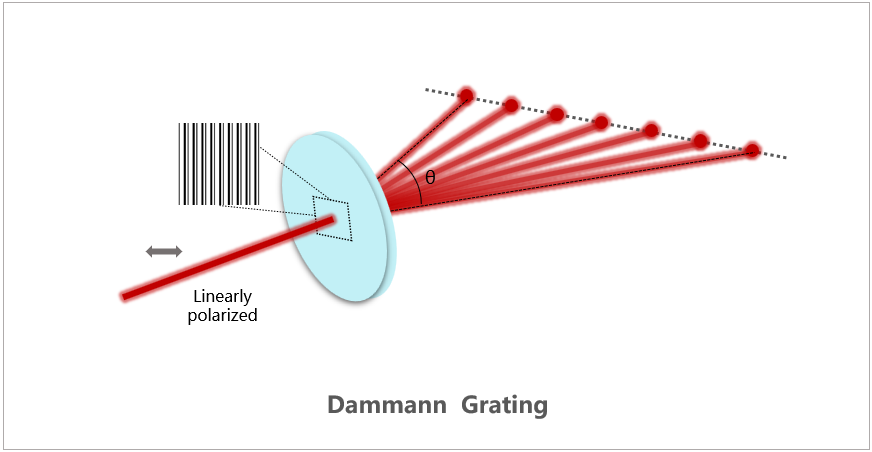
LBTEK Dammann Grating (DG) is fabricated from birefringent liquid crystal polymer (LCP) and N-BK7 glass substrates, featuring a sandwich structure consisting of front and rear glass substrates with a central LCP functional layer. The device has no mechanical housing and features a flat edge on one side. Within the LCP layer, the fast-axis orientation of the liquid crystal molecules exhibits a periodic 0°–90° binary variation along the x-axis, with λ/2 retardance across the entire device plane, making it a single-wavelength device. The Dammann grating surface consists of a series of position-encoded binary phase structures that can readily split a laser beam into multiple beams of equal intensity. It offers unique advantages including a planar structure, high diffraction efficiency, and a high beamsplitting ratio. Compared to conventional gratings and cascaded grating beamsplitters, the Dammann grating can achieve odd-number beamsplitting and a larger number of spots from a single element. LBTEK offers standard Dammann gratings with operating wavelengths of 532 nm and 1064 nm, with a beamsplitting pattern of 1×7 and beamsplitting angles of 2° and 4°, respectively. The standard products are unmounted with a single 1.5 mm flat edge. LBTEK also supports flexible customization of specifications to accommodate diverse requirements across different application scenarios. For more information, please contact LBTEK Technical Support.
Diagram
Attributes
Component MaterialLiquid Crystal Polymer/N-BK7 Window
Component sizeØ25.4 × 3.2 mm, D-type 1.5 mm Flat Edge
Retardance Accuracy±5 nm
Surface Quality (Scratch/Dig)60/40
Delay Uniformity±5 nm
Operating Temperature-20~60℃
Beam splitting uniformity> 85%
1D Dammann Grating
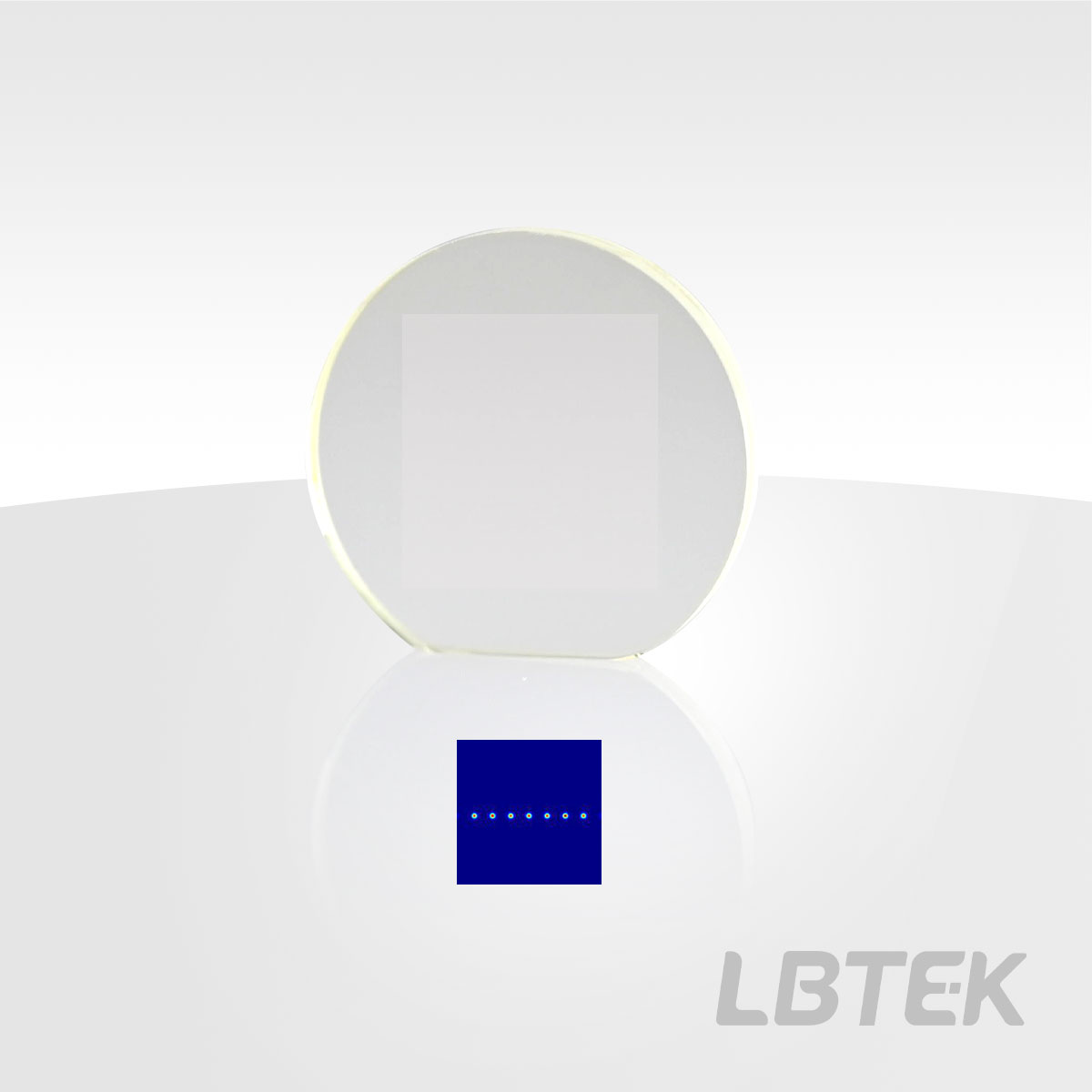
- Linearly Polarized Light Incidence Enables Uniform 1D 1×7 Beamsplitting
- Odd-Number Beamsplitting with High Diffraction Efficiency and High Beamsplitting Ratio
- Standard Wavelengths of 532 nm and 1064 nm Available
LBTEK 1D 1×7 Dammann Grating has a phase difference of π between adjacent strip regions, enabling uniform 1×7 beamsplitting. When linearly polarized light is incident, the beamsplitting uniformity is maximized and the diffraction efficiency can reach the theoretical value. The standard products are unmounted with a 1.5 mm flat edge on one side, and the flat edge direction is parallel to the grating lines. The period of the standard 1×7 Dammann Grating is 90 μm. To ensure beamsplit spot uniformity, an incident spot diameter greater than 0.3 mm is recommended.

Structure of the 1×7 Dammann Grating Under a Polarizing Microscope
Product Model | Operating Wavelength | Beam splitting mode | Maximum Beam Splitting Angle (Full Angle) | File | Unit Price | Compare | Lead Time | ||
|---|---|---|---|---|---|---|---|---|---|
 | DG25-1702-532 | 532 nm | 1 × 7 | 2° | $1,090.38 | 5 weeks | Add Cart | ||
| DG25-1704-1064 | 1064 nm | 1 × 7 | 4° | $1,090.38 | 5 weeks | Add Cart |

Email: support@lbtek.com
Tel: 400-060-6986 (Mon-Sun 9:00-18:00)
 WeChat
 TikTok
 Zhihu
Zhihu Bilibili
Copyright © 2018-2026 Shenzhen Lubon Optical Technology Co., Ltd.All Rights Reserved.| 粤公网安备44030002012430号|粤ICP备18058666号-1
User Agreement andPrivacy Policy粤公网安备44030002012430号|粤ICP备18058666号-1