We are in the midst of a second quantum revolution, centered on quantum technology. Quantum precision measurement, quantum computing, and quantum communication—the three pillars of this transformation—together form the foundation for future information technology and cutting-edge scientific exploration. While these three directions have different application scenarios, they are unified at their core by the precise preparation, high-fidelity manipulation, efficient transmission, and accurate readout of quantum states of microscopic particles such as single photons and atoms. This is precisely the focus of our specialization in quantum optomechanical components and instrumental system solutions. Our goal is to directly address and resolve the common academic challenges in these fields: how to suppress environmental noise to break through the shot-noise limit and achieve measurements that surpass classical limits, approaching the Heisenberg limit; how to enhance the coherence time and control fidelity of qubits to build scalable, fault-tolerant quantum computing systems; and how to overcome channel loss and decoherence effects to extend the distance and bit rate of secure quantum communication. By providing stable, reliable, and integrated quantum optomechanical system solutions, we are committed to removing obstacles for our partners in research and industry, working together to accelerate the arrival of the quantum era.
Quantum Computing
Quantum computing is a revolutionary computing technology that operates according to the principles of quantum mechanics. By leveraging the superposition and entanglement properties of quantum bits (qubits), it enables parallel computational capabilities far beyond those of classical computers when solving specific complex problems. As a milestone achievement in the development of quantum computing, the "Jiuzhang" optical quantum computing prototype stands as a quintessential example designed to demonstrate "quantum computational advantage" in specific problem-solving contexts. Unlike quantum communication and precision measurement, which rely on high-precision manipulation of a small number of quantum states, Jiuzhang is characterized by its extreme scalability and parallelism. Rather than constructing a universal quantum gate architecture, it tackles the classically intractable "Boson Sampling" problem through a massive and fixed 100-mode linear optical interferometer. The core photonic challenge lies in full connectivity and phase stability: enabling high-precision interference between every pair of the 100 spatial optical modes imposes unprecedented demands on mechanical stability and resistance to environmental perturbations in the optical setup. This was addressed by fabricating the entire interferometer on a monolithic, ultra-low expansion glass-ceramic substrate with an exceptionally low thermal expansion coefficient, complemented by active phase-locking technology to compensate for phase drift. This field extensively employs ultrafast pulsed lasers and ppKTP nonlinear crystal arrays to generate squeezed light states, while relying on a vast array of high-precision components—including mirrors, beam splitters, precision adjustable mounts, and single-mode fibers—to construct the interference network. Ultimately, efficient detection is achieved through an array of superconducting nanowire single-photon detectors (SNSPD).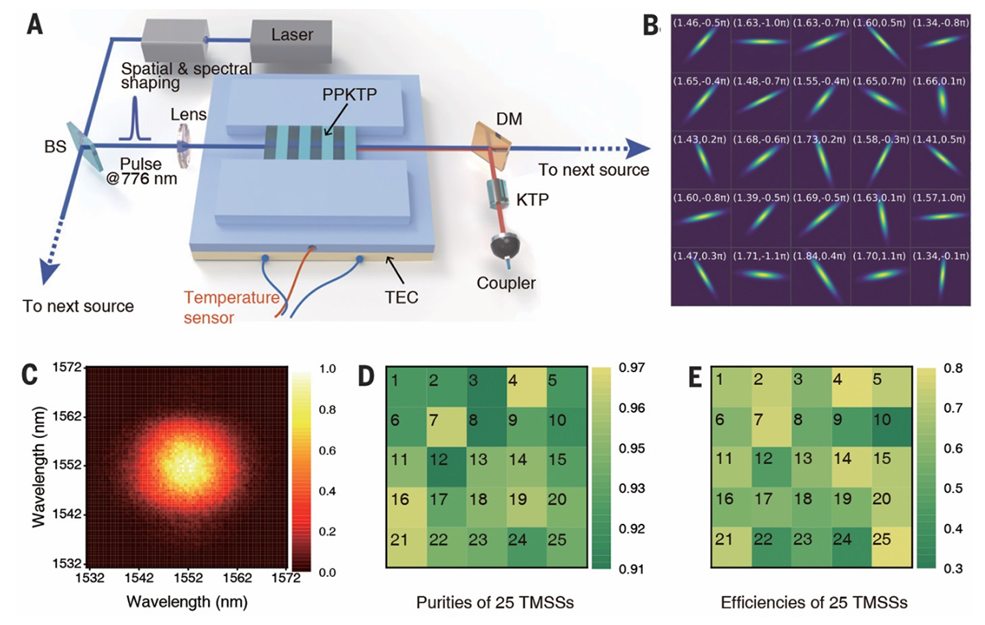
From:Zhong, H.-S., Wang, H., Deng, Y.-H., Chen, M.-C., Luo, Y.-H., Qin, J., Wu, D., Ding, X., Hu, Y., Hu, P., Zhang, W.-J., Li, H., Li, Y., Jiang, X.,
Gan, L., Wang, G.-Z., Li, L., Liu, N.-L., Lu, C.-Y., & Pan, J.-W. (2020). Quantum computational advantage using photons. Science, 370(6523), 1460–1463.
Quantum Communication
The core objective of quantum communication is to achieve unconditionally secure information transmission by leveraging quantum mechanical principles (such as the no-cloning theorem), with its ultimate form envisioned as a "quantum internet" that interconnects distributed quantum processors and sensors. As a critical step toward realizing this vision, the quantum communication network scheme, which integrates standalone solid-state quantum light sources with existing optical fiber networks, effectively demonstrates the feasibility of constructing practical quantum network nodes, representing a highly significant achievement in the field. Unlike traditional quantum key distribution (QKD) schemes based on attenuated lasers, this approach distinguishes itself by employing "on-demand" quantum dot single-photon sources while overcoming their inherent incompatibility with telecommunication fibers. The central photonic challenge lies in the "impedance mismatch" between disparate physical systems: photons emitted by quantum dots (at ~900 nm) suffer severe attenuation in optical fibers, and their spectral linewidths and shapes must be perfectly matched with those of photons from another independent remote source to enable quantum interference. This issue is resolved through an integrated quantum frequency conversion (QFC) module, which utilizes nonlinear crystals to efficiently and low-noise convert quantum dot photons to the telecom C‑band (~1550 nm). This research domain commonly employs cryogenic high-numerical-aperture confocal microscopy for single-photon excitation and collection, relies on nonlinear crystals (e.g., PPLN waveguides) and intense pump lasers for frequency conversion, purifies signals via ultra-narrowband filtering cavities (e.g., Fabry–Pérot etalons), and ultimately performs Bell-state measurements using superconducting nanowire single-photon detectors (SNSPD).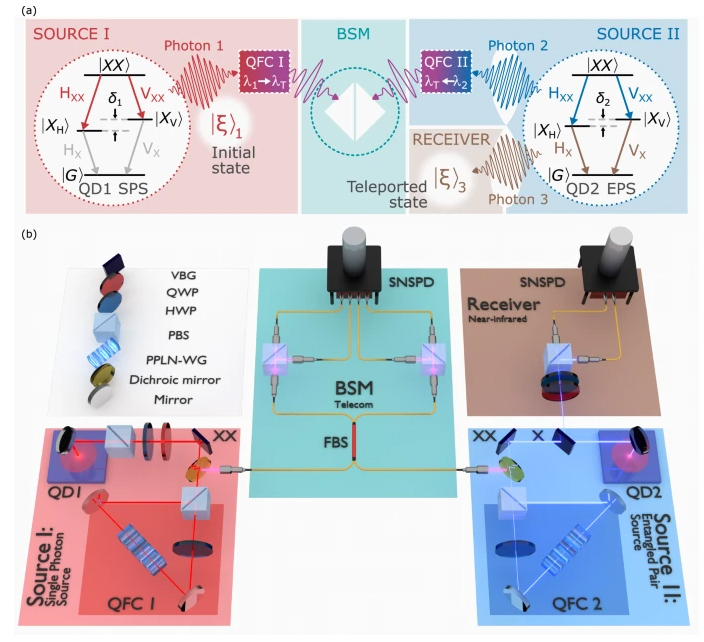
From:Strobel, T., Vyvlecka, M., Neureuther, I. et al. Telecom-wavelength quantum teleportation using frequency-converted photons
from remote quantum dots. Nat Commun 16, 10027 (2025).
Quantum Precision Measurement
Quantum precision measurement aims to leverage quantum resources to surpass the "standard quantum limit (SQL)"—imposed by fundamental fluctuations such as shot noise—thereby enabling ultra-sensitive detection of weak physical signals. As a brilliant demonstration of the successful application of quantum enhancement technology in large-scale scientific projects, the LIGO paper achieves a direct boost in gravitational wave detection sensitivity by injecting non-classical light into its 4‑kilometer-long interferometer, standing as one of the most representative achievements in the field. Unlike measurement schemes that rely on single-photon counting or atomic interference, this work distinguishes itself by employing continuous-variable "squeezed vacuum states" and utilizing an innovative "detuned squeezing" technique, which simultaneously suppresses shot noise at high frequencies and radiation pressure noise at low frequencies. The core photonic challenge lies in the generation, stabilization, and mode-matching of non-classical light with a giant interferometer: the generated squeezed light field must maintain its squeezing properties across an extremely broad frequency range, its spatial mode must be precisely matched to the micron-scale beam of the LIGO main interferometer, and its phase must be locked with high accuracy. This is addressed through an independent, cascaded locking system that includes a second-harmonic generation (SHG) cavity and an optical parametric oscillator (OPO) to produce squeezed light, which is then stably injected into the dark port of the main interferometer via high-precision mode-matching telescopes and active feedback control systems. This research domain frequently employs high-power frequency-stabilized lasers, nonlinear crystals (e.g., PPKTP), high-finesse optical cavities, and relies extensively on electro-optic/acousto-optic modulators, balanced homodyne detectors, and sophisticated PDH (Pound–Drever–Hall) locking electronics to ensure stable operation of the entire system.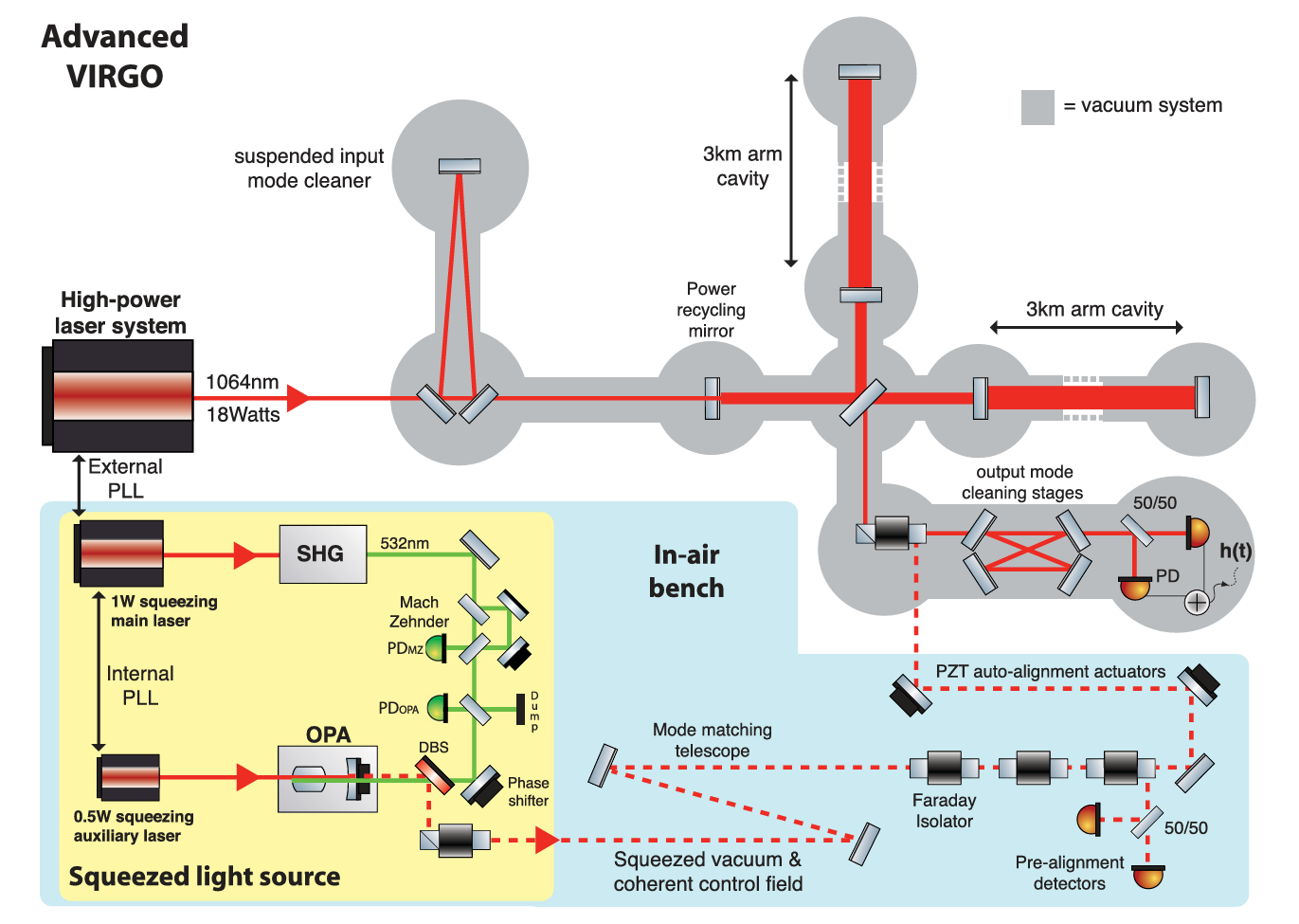
From:The LIGO Scientific Collaboration and the Virgo Collaboration. (2019). First demonstration of detuned squeezing for sub-quantum-noise
gravitational-wave detection. Physical Review Letters, 123(23), 231108.
%20--%3e%3csvg%20version='1.1'%20id='图层_1'%20xmlns='http://www.w3.org/2000/svg'%20xmlns:xlink='http://www.w3.org/1999/xlink'%20x='0px'%20y='0px'%20viewBox='0%200%20289.2%2071.5'%20style='enable-background:new%200%200%20289.2%2071.5;'%20xml:space='preserve'%3e%3cstyle%20type='text/css'%3e%20.st0{fill-rule:evenodd;clip-rule:evenodd;fill:%23B81C22;}%20.st1{fill:%23B81C22;}%20%3c/style%3e%3cg%3e%3cpath%20class='st0'%20d='M286.5,2.7c-0.2-0.5-0.7-1-1.6-1c-4.1,0-9.1,0-9.1,0c-2.9,0-6.1,3.1-6.1,3.1c0,0-13,14.6-21.8,23.4l-1,1%20l2.3-18.7c0.3-2.2-0.4-4.5-1.9-6.1c-1.5-1.7-3.6-2.7-5.9-2.7h-2.8c-1,0-1.8,0.7-1.9,1.7l-8.3,65.1c-0.1,0.5,0.1,1.1,0.5,1.5%20c0.4,0.4,0.9,0.7,1.4,0.7h3c4.8,0,8.8-3.5,9.4-8.3l1.8-14.2l6.6-6.6l0.3,0.5c3.5,5.3,16.2,24.4,16.9,25.6c0.4,0.4,1.9,3.1,6.2,3.1%20l8.6-0.1c0.8,0,1.4-0.4,1.7-1.1c0.3-0.7,0.3-1.4-0.1-2.1l-22.1-32.5c-1.2-1.7-1-4,0.5-5.5l23.1-24.8C286.7,3.9,286.7,3.2,286.5,2.7%20'/%3e%3cpath%20class='st0'%20d='M174.4,14.3C174.4,14.3,174.4,14.2,174.4,14.3L176,4c0.1-0.7-0.1-1.3-0.5-1.8c-0.4-0.5-1.1-0.8-1.8-0.8h-50.4%20c-1.5,0-3,1.2-3.2,2.7l-1.3,10.2h21.1l-7.1,56.2l13.1,0c0.1,0,0.1-0.1,0.1-0.1l7.4-56.2H174.4z'/%3e%3cpath%20class='st0'%20d='M13,1.4h-2.6c-0.9,0-1.8,0.8-1.9,1.7L0.8,64.4c-0.2,1.6,0.2,3,1.2,4.1c1,1.1,2.5,1.8,4.1,1.8h39.7%20c1.3,0,2.4-1,2.6-2.3c0.4-3-0.4-5.8-2.3-7.9c-1.9-2.1-4.6-3.3-7.6-3.3H23.7c-1.6,0-3.1-0.7-4.1-1.9c-1.1-1.2-1.5-2.8-1.3-4.3%20L23,12.7c0.4-3-0.4-5.8-2.3-8C18.8,2.6,16.1,1.4,13,1.4'/%3e%3cpath%20class='st0'%20d='M223,40.3c0.3,0,0.5-0.2,0.6-0.5l1.1-8.4c0-0.1,0-0.2-0.1-0.3c-0.1-0.1-0.1-0.1-0.3-0.1h-8%20c-0.3,0-0.5,0.2-0.6,0.5l-1.1,8.4c0,0.1,0,0.2,0.1,0.3c0.1,0.1,0.1,0.1,0.3,0.1H223z'/%3e%3cpath%20class='st0'%20d='M229,1.4h-35.4c-6.9,0-13.1,5.5-14,12.3L174,58c-0.4,3.3,0.5,6.4,2.6,8.7c2,2.3,4.9,3.6,8.2,3.6h35.8l0.5-5%20c0.2-2.1-0.5-4.1-1.9-5.7c-1.4-1.5-3.4-2.4-5.5-2.4l-17.2,0c-2.2,0-4.2-0.9-5.6-2.5c-1.4-1.6-2-3.7-1.8-6c0.6-4.5,4.7-8.3,9.3-8.3%20l11.5,0c0.3,0,0.6-0.2,0.6-0.5l1-8.3c0-0.1,0-0.2-0.1-0.3c-0.1-0.1-0.2-0.1-0.3-0.1l-11.6,0h0c-3.2,0-5.5-1.3-6.6-3.6%20c-1.3-2.8-1.1-6,0.6-8.6c1.8-2.8,4.8-4.5,8-4.5h18.1c4.5,0,8.3-3.3,8.8-7.8L229,1.4z'/%3e%3cpath%20class='st1'%20d='M112.3,9.9c-1.5-2.9-3.8-5.1-7-6.5c-3.1-1.4-7.4-2.1-12.8-2.1l-25.4,0h0c-2.5,0-4.8,2-5.1,4.5l-7.3,57.9%20c-0.2,1.8,0.3,3.4,1.4,4.7c1.1,1.3,2.7,1.9,4.5,1.9h23.5c4.5,0,8.4-0.4,11.6-1.2c3.2-0.8,6-1.9,8.3-3.5c2.3-1.5,4.4-3.8,6.2-6.6%20c1.8-2.8,2.9-5.9,3.3-9.1c0.5-4.1-0.2-7.6-2.2-10.6c-1.6-2.4-3.9-4.3-7-5.6l-0.9-0.4l0.9-0.5c2.5-1.4,4.6-3.2,6.1-5.3%20c2-2.7,3.2-5.5,3.6-8.5C114.4,15.9,113.8,12.8,112.3,9.9%20M101.5,21.7c-0.5,4-4,7.1-7.9,7.2H78.4l-0.2,1.3c-0.3,2.7,0.4,5.2,2.1,7.1%20c1.7,1.9,4.1,2.9,6.8,2.9h3.4c0.6,0,1.2,0.1,1.7,0.2c0.3,0,0.6,0.1,0.8,0.2l0,0.5l0.1-0.5c3.5,1.1,5.5,4.4,5.1,8.2%20c-0.6,4.6-4.8,8.4-9.5,8.4H71.4c-0.6,0-1.2-0.3-1.6-0.7c-0.4-0.5-0.6-1-0.5-1.6l4.9-38.6c0.1-1.1,1-1.8,2.1-1.8h0%20c15.3,0,18.2,0,18.8,0l0,0c1.9,0,3.7,0.8,4.9,2.1C101.2,17.9,101.7,19.7,101.5,21.7'/%3e%3c/g%3e%3c/svg%3e)

 WeChat
 TikTok
 Zhihu
Zhihu Bilibili
 粤公网安备44030002012430号|粤ICP备18058666号-1