%20--%3e%3csvg%20version='1.1'%20id='图层_1'%20xmlns='http://www.w3.org/2000/svg'%20xmlns:xlink='http://www.w3.org/1999/xlink'%20x='0px'%20y='0px'%20viewBox='0%200%20289.2%2071.5'%20style='enable-background:new%200%200%20289.2%2071.5;'%20xml:space='preserve'%3e%3cstyle%20type='text/css'%3e%20.st0{fill-rule:evenodd;clip-rule:evenodd;fill:%23B81C22;}%20.st1{fill:%23B81C22;}%20%3c/style%3e%3cg%3e%3cpath%20class='st0'%20d='M286.5,2.7c-0.2-0.5-0.7-1-1.6-1c-4.1,0-9.1,0-9.1,0c-2.9,0-6.1,3.1-6.1,3.1c0,0-13,14.6-21.8,23.4l-1,1%20l2.3-18.7c0.3-2.2-0.4-4.5-1.9-6.1c-1.5-1.7-3.6-2.7-5.9-2.7h-2.8c-1,0-1.8,0.7-1.9,1.7l-8.3,65.1c-0.1,0.5,0.1,1.1,0.5,1.5%20c0.4,0.4,0.9,0.7,1.4,0.7h3c4.8,0,8.8-3.5,9.4-8.3l1.8-14.2l6.6-6.6l0.3,0.5c3.5,5.3,16.2,24.4,16.9,25.6c0.4,0.4,1.9,3.1,6.2,3.1%20l8.6-0.1c0.8,0,1.4-0.4,1.7-1.1c0.3-0.7,0.3-1.4-0.1-2.1l-22.1-32.5c-1.2-1.7-1-4,0.5-5.5l23.1-24.8C286.7,3.9,286.7,3.2,286.5,2.7%20'/%3e%3cpath%20class='st0'%20d='M174.4,14.3C174.4,14.3,174.4,14.2,174.4,14.3L176,4c0.1-0.7-0.1-1.3-0.5-1.8c-0.4-0.5-1.1-0.8-1.8-0.8h-50.4%20c-1.5,0-3,1.2-3.2,2.7l-1.3,10.2h21.1l-7.1,56.2l13.1,0c0.1,0,0.1-0.1,0.1-0.1l7.4-56.2H174.4z'/%3e%3cpath%20class='st0'%20d='M13,1.4h-2.6c-0.9,0-1.8,0.8-1.9,1.7L0.8,64.4c-0.2,1.6,0.2,3,1.2,4.1c1,1.1,2.5,1.8,4.1,1.8h39.7%20c1.3,0,2.4-1,2.6-2.3c0.4-3-0.4-5.8-2.3-7.9c-1.9-2.1-4.6-3.3-7.6-3.3H23.7c-1.6,0-3.1-0.7-4.1-1.9c-1.1-1.2-1.5-2.8-1.3-4.3%20L23,12.7c0.4-3-0.4-5.8-2.3-8C18.8,2.6,16.1,1.4,13,1.4'/%3e%3cpath%20class='st0'%20d='M223,40.3c0.3,0,0.5-0.2,0.6-0.5l1.1-8.4c0-0.1,0-0.2-0.1-0.3c-0.1-0.1-0.1-0.1-0.3-0.1h-8%20c-0.3,0-0.5,0.2-0.6,0.5l-1.1,8.4c0,0.1,0,0.2,0.1,0.3c0.1,0.1,0.1,0.1,0.3,0.1H223z'/%3e%3cpath%20class='st0'%20d='M229,1.4h-35.4c-6.9,0-13.1,5.5-14,12.3L174,58c-0.4,3.3,0.5,6.4,2.6,8.7c2,2.3,4.9,3.6,8.2,3.6h35.8l0.5-5%20c0.2-2.1-0.5-4.1-1.9-5.7c-1.4-1.5-3.4-2.4-5.5-2.4l-17.2,0c-2.2,0-4.2-0.9-5.6-2.5c-1.4-1.6-2-3.7-1.8-6c0.6-4.5,4.7-8.3,9.3-8.3%20l11.5,0c0.3,0,0.6-0.2,0.6-0.5l1-8.3c0-0.1,0-0.2-0.1-0.3c-0.1-0.1-0.2-0.1-0.3-0.1l-11.6,0h0c-3.2,0-5.5-1.3-6.6-3.6%20c-1.3-2.8-1.1-6,0.6-8.6c1.8-2.8,4.8-4.5,8-4.5h18.1c4.5,0,8.3-3.3,8.8-7.8L229,1.4z'/%3e%3cpath%20class='st1'%20d='M112.3,9.9c-1.5-2.9-3.8-5.1-7-6.5c-3.1-1.4-7.4-2.1-12.8-2.1l-25.4,0h0c-2.5,0-4.8,2-5.1,4.5l-7.3,57.9%20c-0.2,1.8,0.3,3.4,1.4,4.7c1.1,1.3,2.7,1.9,4.5,1.9h23.5c4.5,0,8.4-0.4,11.6-1.2c3.2-0.8,6-1.9,8.3-3.5c2.3-1.5,4.4-3.8,6.2-6.6%20c1.8-2.8,2.9-5.9,3.3-9.1c0.5-4.1-0.2-7.6-2.2-10.6c-1.6-2.4-3.9-4.3-7-5.6l-0.9-0.4l0.9-0.5c2.5-1.4,4.6-3.2,6.1-5.3%20c2-2.7,3.2-5.5,3.6-8.5C114.4,15.9,113.8,12.8,112.3,9.9%20M101.5,21.7c-0.5,4-4,7.1-7.9,7.2H78.4l-0.2,1.3c-0.3,2.7,0.4,5.2,2.1,7.1%20c1.7,1.9,4.1,2.9,6.8,2.9h3.4c0.6,0,1.2,0.1,1.7,0.2c0.3,0,0.6,0.1,0.8,0.2l0,0.5l0.1-0.5c3.5,1.1,5.5,4.4,5.1,8.2%20c-0.6,4.6-4.8,8.4-9.5,8.4H71.4c-0.6,0-1.2-0.3-1.6-0.7c-0.4-0.5-0.6-1-0.5-1.6l4.9-38.6c0.1-1.1,1-1.8,2.1-1.8h0%20c15.3,0,18.2,0,18.8,0l0,0c1.9,0,3.7,0.8,4.9,2.1C101.2,17.9,101.7,19.7,101.5,21.7'/%3e%3c/g%3e%3c/svg%3e)
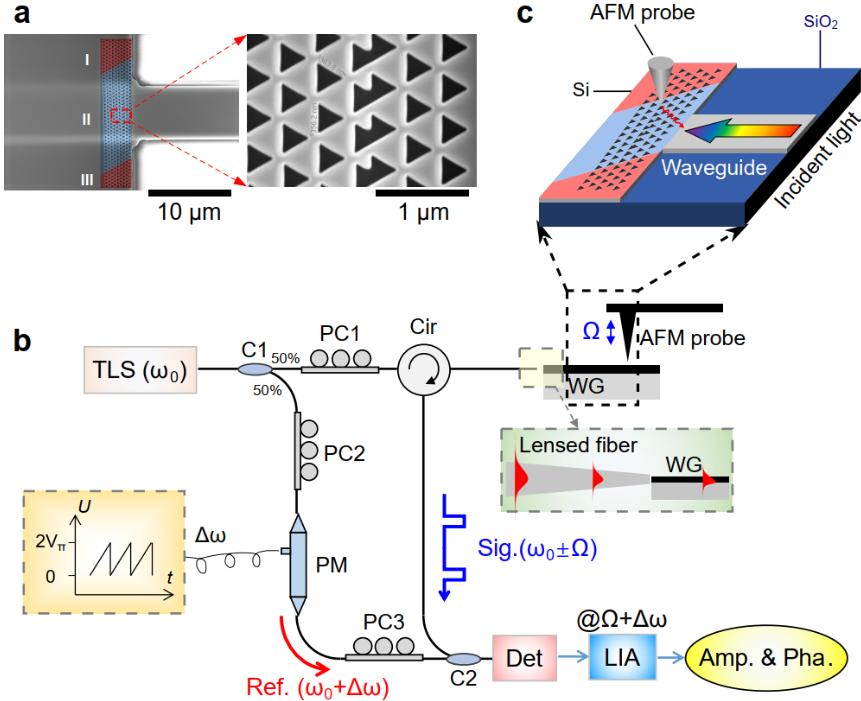
From:Lu, C., Sun, YZ., Wang, C. et al. On-chip nanophotonic topological rainbow. Nat Commun 13, 2586 (2022).
The implementation of these approaches relies on optical components with high damage thresholds, high-stability mechanical mounts, and high-pixel cameras for optical path control and quality monitoring. In micro‑/nano‑fabrication processes, galvanometer systems are widely used for precision scanning control, operating on closed-loop negative feedback principles to drive X/Y-axis mirrors for wide-angle beam steering. Spatial light modulators (SLMs), utilizing liquid crystal phase modulation, transform Gaussian beams into flat-top profiles with uniform energy distribution and support real-time dynamic adjustments to meet diverse processing requirements. Additionally, diffractive optical elements (DOEs), with their nanoscale grating structures, achieve similar homogenization effects in a more compact form factor, making them suitable for highly integrated micro‑/nano‑fabrication systems. For ultra-precision machining applications, high-pixel, high-resolution imaging techniques are commonly employed in research to enable real-time monitoring of micron-scale surface morphology. Finally, in system integration, the use of high-damage-threshold optical components on quartz substrates, combined with multilayer dielectric coating technology, ensures the ability to withstand high-energy pulse densities, thereby maintaining stability and precision throughout the fabrication process.
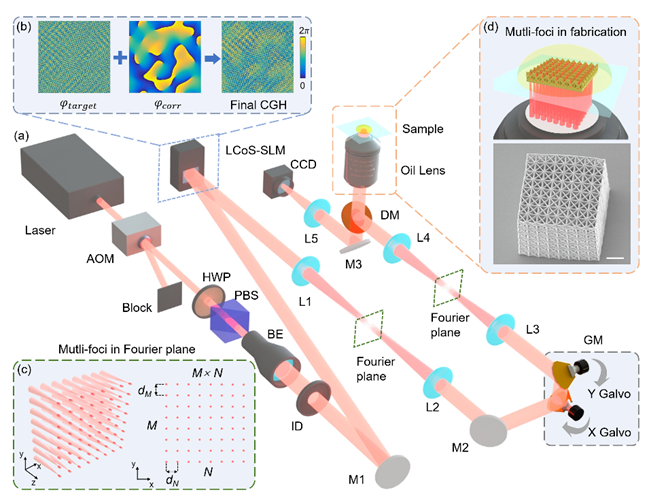
From:Zhang L, Wang C, Zhang C, Xue Y, Ye Z, Xu L, Hu Y, Li J, Chu J, Wu D. High-Throughput Two-Photon 3D Printing Enabled by Holographic Multi-Foci High-Speed Scanning. Nano Lett. 2024 Feb 28;24(8):2671-2679.
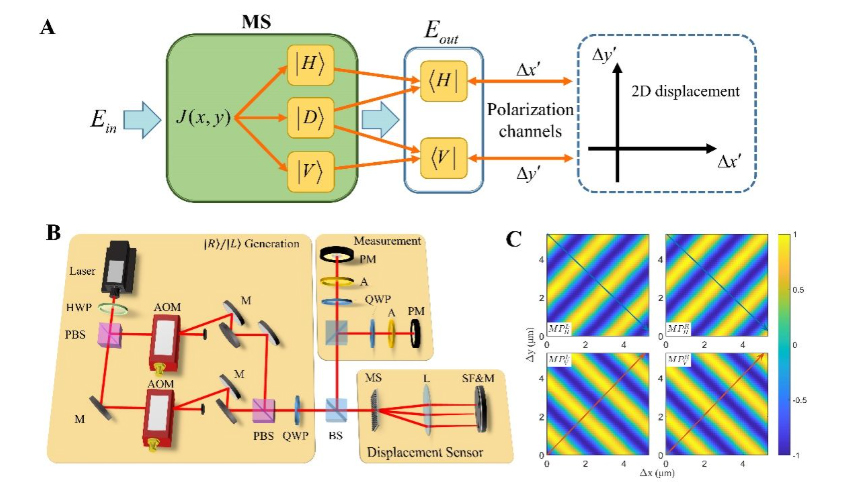
From:Haofeng Zang et al.,High-precision two-dimensional displacement metrology based on matrix metasurface.Sci. Adv.10,eadk2265(2024).
· Relying on liquid-crystal micro‑nano photonics technology, LBTEK has established China’s first mass‑production line with scalable capacity, equipped with advanced processing tools and full-process capabilities. This ensures high design freedom, manufacturing precision, and reliability for high‑accuracy micro‑nano optical components.
· In the domain of beam shaping, LBTEK supplies key optical elements such as high‑precision phase plates, diffractive lenses, and beam splitters, meeting diverse needs including beam homogenization, wavefront shaping, and energy distribution. Utilizing proprietary phase‑modulation and surface‑relief processes, its homogenizing diffractive optical elements (DOEs) offer low absorption and high damage thresholds, enabling efficient shaping and uniformization of Gaussian beams—particularly suitable for high‑energy‑density applications in the visible and near‑infrared bands.
· High‑extinction‑ratio polarizing beam splitters and true zero‑order waveplates with high phase accuracy allow high‑fidelity polarization control, providing stable support for topological‑state excitation, polarization‑sensitive measurements, and high‑contrast imaging.
· For optical field measurement and detection systems, LBTEK offers high‑precision spatial light modulators (SLMs) capable of independent phase modulation, supporting the construction of functional systems such as holographic multi‑focus processing, optical tweezers, and selective excitation of topological modes. The systems are also equipped with high‑accuracy polarimetric analyzers and high‑power optical power meters for real‑time monitoring of energy distribution, polarization response, and optical field stability.
· At the system‑integration level, LBTEK’s optical tweezers platform enables visual demonstration of laser‑controlled particle dynamics, providing an experimental foundation for studying topological edge‑state transport, optomechanical interactions, and high‑dimensional light‑field manipulation.
LBTEK implements a modular design philosophy across all products, and its optical coating processes are optimized for environmental adaptability, ensuring stable performance under varying temperatures, mechanical vibrations, and other complex conditions. Beyond hardware, we deliver full‑cycle technical services—including optical design consultation, system integration, hands‑on training, and long‑term support—to help customers fully leverage the performance advantages of LBTEK’s advanced optical imaging and opto‑mechanical solutions.

Email: support@lbtek.com
Tel: 400-060-6986 (Mon-Sun 9:00-18:00)
 WeChat
 TikTok
 Zhihu
Zhihu Bilibili